Encounter a forest indoors
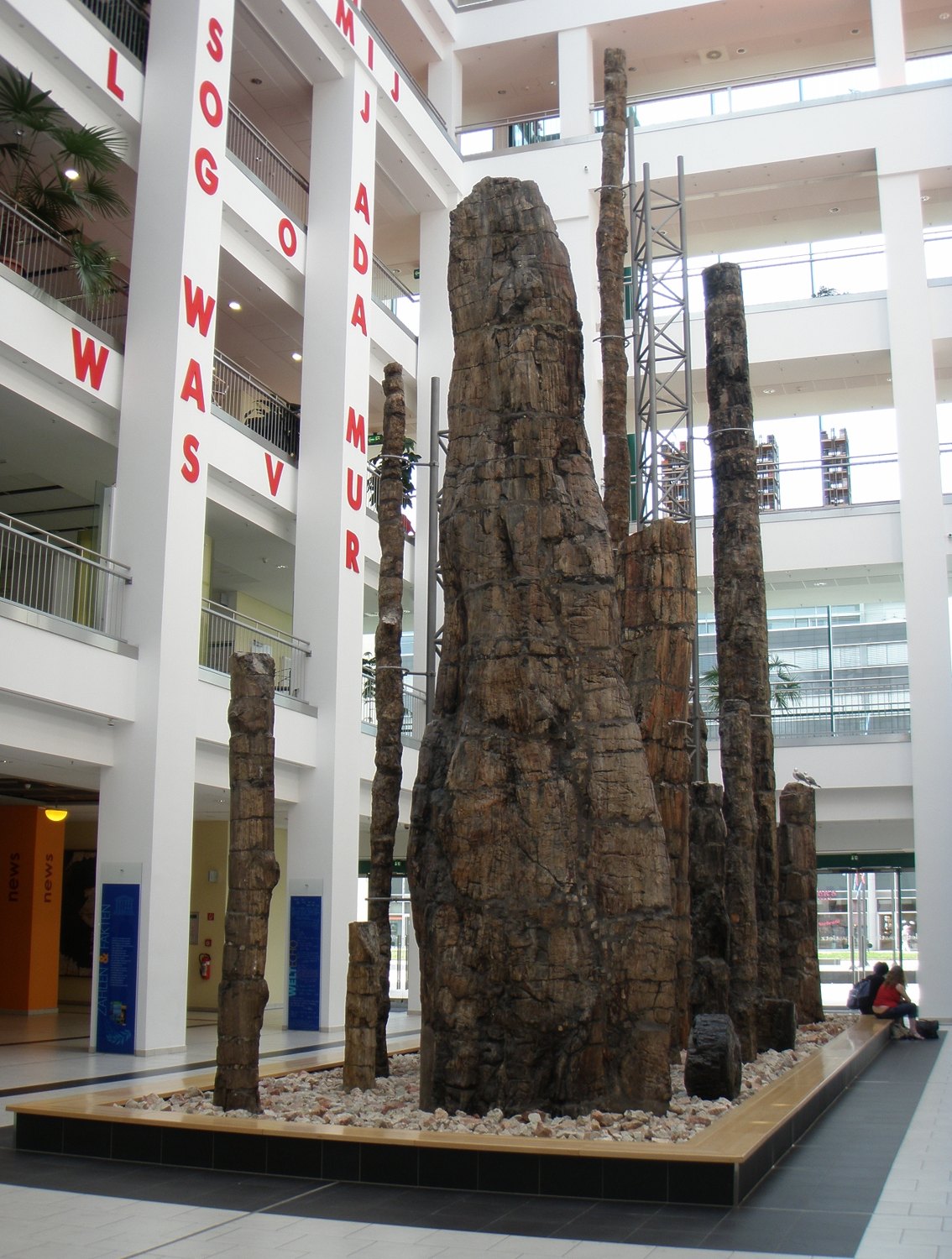
The fossil trunks in the TIETZ atrium initially attract attention through their scale. Before reading the interpretation, compare their forms. Which pieces are recognisable as trunks, where are breaks visible, and how do the surfaces differ? These observations give the scientific explanation something concrete to connect with.
The city describes the finds as evidence of a forest roughly 290 million years old, preserved through processes involving volcanic activity and silicification. This is a different timescale from the history of the buildings outside. The distance between a medieval structure and such a fossil is not simply a slightly longer historical interval; it belongs to a fundamentally different scale of time.
Petrified is not the same as burnt
The appearance of a trunk can suggest old wood or a charred remnant. Interpretation of silicification helps correct that first impression. Look at the explanation of preservation as well as the outline of the object. Something retaining the appearance of wood does not necessarily retain the same material properties today.
Touch the exhibits only where this is explicitly allowed. Being made of stone does not make every surface insensitive or available for handling. Light, colour and visible structure often provide enough for comparison. An overall photograph and a permitted close detail can record those differences more usefully than several almost identical views.
Separate discovery from display
The trunks are now presented in a cultural centre, but that does not mean the forest was excavated at precisely that location. Municipal information refers particularly to discoveries in Hilbersdorf. Check the origin recorded for individual objects and distinguish the place of discovery, subsequent scientific work and the current display.
Museums arrange material so that visitors can understand relationships that may be difficult to see at an excavation. At the same time, an arrangement should not automatically be treated as an exact reconstruction of one former patch of forest. If that question interests you, consult the interpretation or ask at the natural history museum.
Talk about scale with children
Begin with visible features rather than several technical terms at once. Compare the thickness of two trunks or find surfaces that look different. Then ask how researchers identify the plant to which a find belonged. This moves from observation towards explanation and gives children a question they can actually investigate in the display.
Access to the atrium follows the building's opening arrangements and rules. Visiting further natural-history exhibitions requires a separate check of admission and hours. If the subject has caught your attention, that additional visit is more useful than trying to answer every question from the large atrium display alone. The first encounter can remain a starting point rather than becoming a complete lesson. A later look at the museum's own research information can extend it without requiring everyone in the group to spend the same amount of time on the subject.