Industry as an urban structure
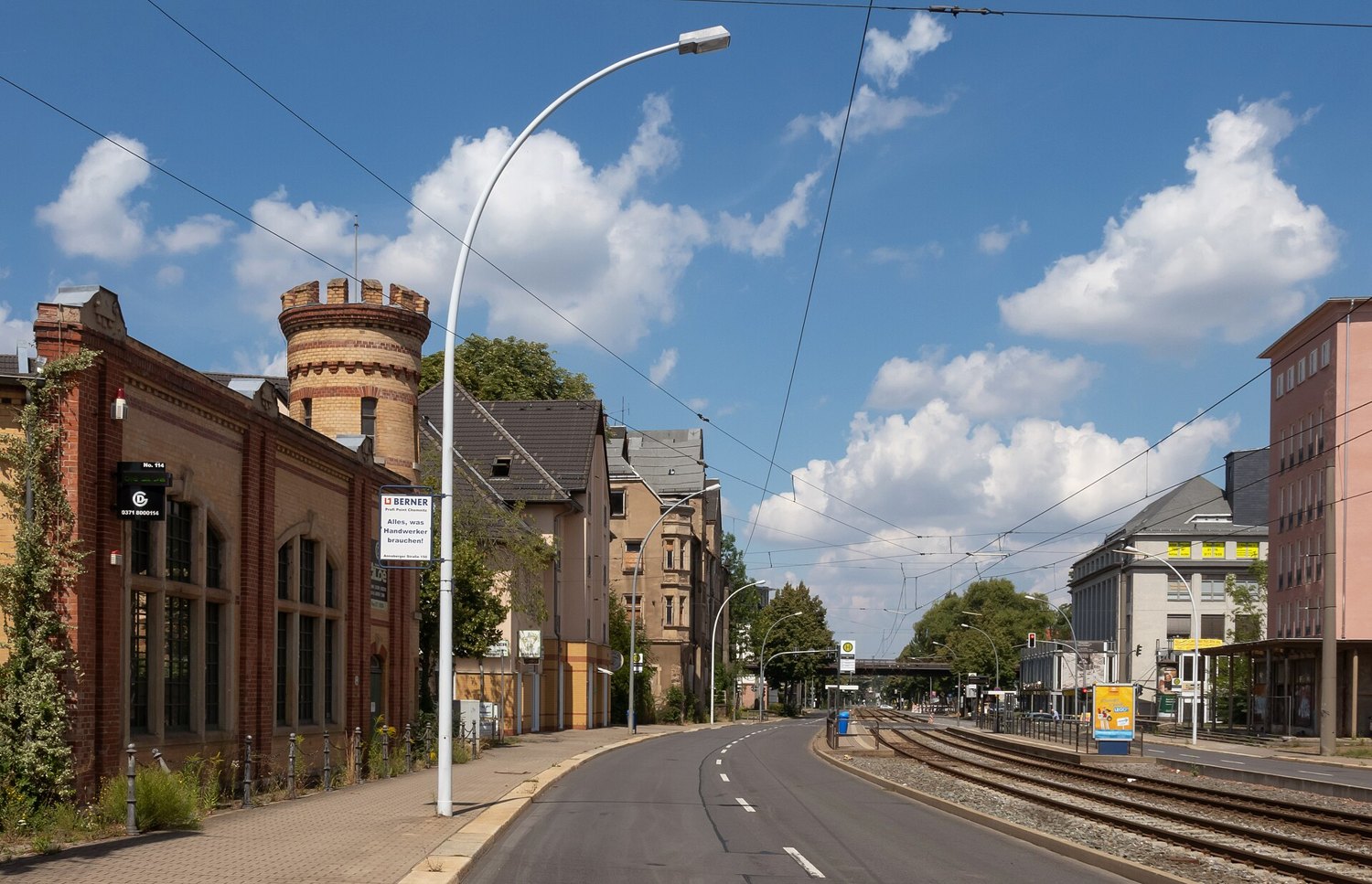
Altchemnitz makes more sense when you look beyond a search for one famous machine. Large plots, long façades, railway land and access roads shape the area. Municipal development material describes its proximity to the centre and the significance of historic factories. For a walk, this suggests looking at relationships: production needed space, transport and buildings on a different scale from an ordinary house.
Start from a clearly named destination around Annaberger Straße or Altchemnitzer Straße and mark an actual route on a map. Industrial sites can be close together yet separated by fences, tracks or private roads. A possible shortcut through a complex should not be treated as part of a reliable pedestrian itinerary.
Two examples with different visiting arrangements
Wirkbau and the Spinnbau site illustrate the reuse of industrial buildings. At Wirkbau, you can examine the structures and prominent clock tower from public routes. Entering businesses or other interiors requires a specific reason and the relevant user's permission. Describing somewhere as a creative location does not make every room open to visitors.
At Spinnbau, a theatre performance can become a separate part of the day. The production, stage and admission time then determine the visit. An evening show is different from an exterior architectural walk during the afternoon. To combine them, explore the surroundings in daylight and leave sufficient time to locate the correct theatre entrance afterwards.
In either case, consider which elements appear older and which have clearly been added. Record observations rather than assuming that one new doorway means an entire complex has been renovated. Large industrial properties can contain several owners, construction phases and uses at the same time. That coexistence is part of their interest.
This is not an invitation to explore restricted buildings
Stay on public streets and explicitly permitted paths. A broken window or unused wing does not imply a right to enter. Deliveries, construction work and operating businesses have needs that differ from those of a sightseeing route. Leave access roads clear and do not follow apparent tracks behind barriers.
Long views are often more informative than photographs through a fence. Show how a façade meets a street or how several building sections relate to one another. If making detail images, save an overall view first. It will later explain whether an inscription, window or change of material belonged to the same structure.
Read history without confusing it with current access
The city has published development objectives and regeneration projects for Altchemnitz over many years. These documents provide background on reuse, but they are not current visitor instructions. An earlier vacancy figure, proposed bridge or suggested activity does not establish what is open or complete on the day you arrive.
Check particular events with their operator and current routes on an up-to-date map. For explanations of technology, the industrial museum is a possible complementary visit at another location. Its objects and interpretation address production processes; the Altchemnitz walk shows the urban scale. The two experiences can support each other without being forced into one tight block of time.
Give the walk a clear endpoint
After several buildings, finish at a suitable stop or a planned route back to the centre. A break matters particularly on streets where traffic noise or weather makes concentration tiring. A short, deliberate circuit can then be more useful than walking past every name on an industrial-heritage map.
Carry one question with you: how is present-day work visible within the former production landscape? Signs, entrances and ground-floor uses can provide answers without access to private areas. The purpose is to understand urban change in a real setting, not to find the largest possible number of abandoned corners. That distinction also makes the outing suitable for people whose interest is architecture or city history rather than machinery alone.