Give the district its own walk
Sonnenberg extends between inner urban areas and Zeisigwald. The city's account of its development describes a working-class neighbourhood shaped by late nineteenth-century growth. That provides historical context, not a complete account of everyday life today. A useful visit starts with a few connected streets rather than a fixed judgement about the entire district.
Choose a beginning and an endpoint before setting off. A circuit near the main station has a different scale from a walk all the way to the woods. Do not combine the two unintentionally. If approaching from the station, check the actual pedestrian connection and allow for crossings. Seeing a destination beyond railway tracks does not establish a direct walking route to it.
Read buildings together
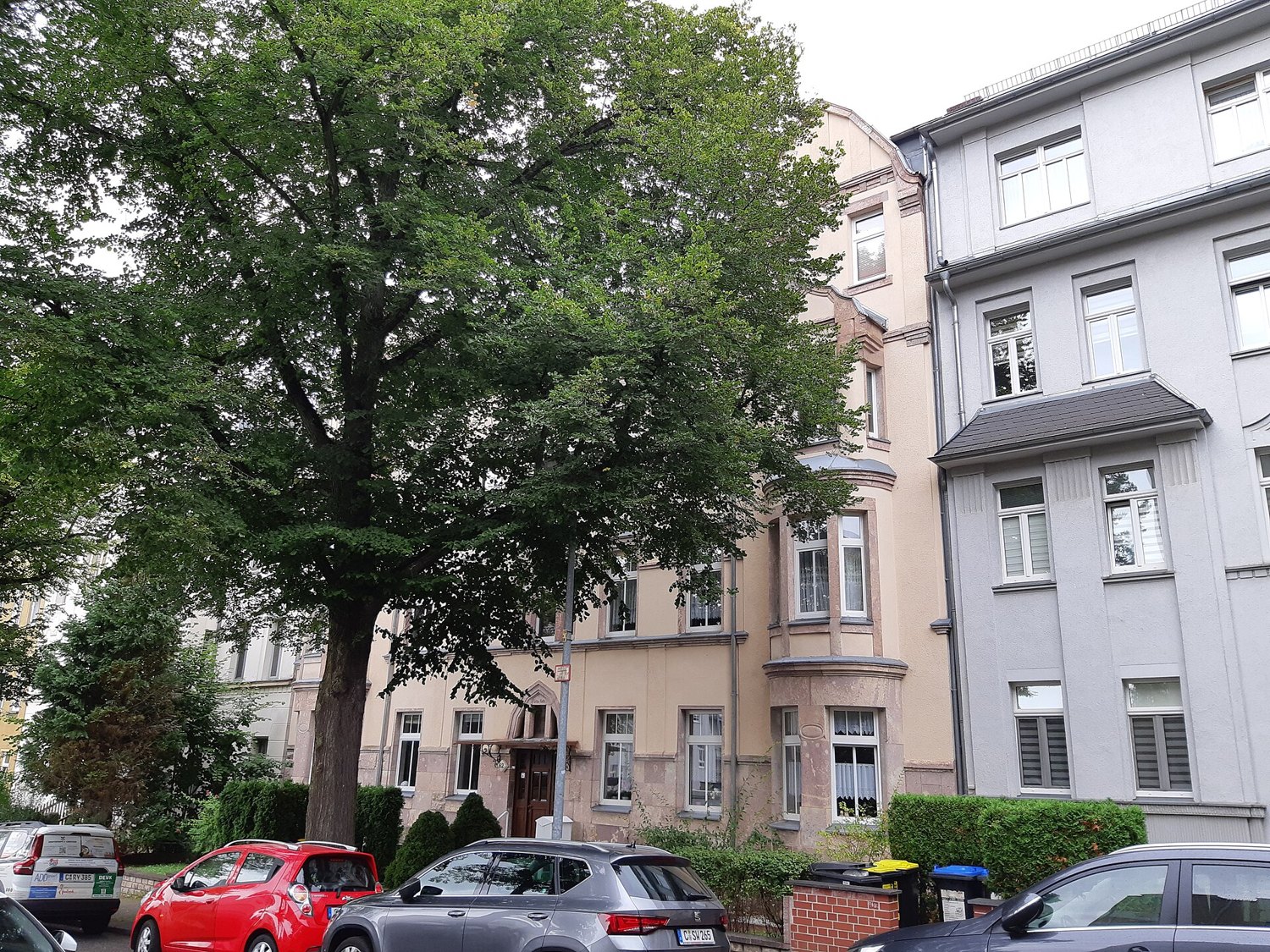
Older residential streets offer opportunities to examine the treatment of corners, entrances and upper floors. Fürstenstraße and its neighbouring streets provide one framework; select a small section instead of trying to find every architectural feature at once. A building on a junction plays a different role from a similar volume in the middle of a row. Notice how a corner building addresses both streets.
Look also at the relationship between houses and pavement. Where do trees stand, where do gaps open up, and where is the frontage continuous? These observations do not require labelling the district beautiful, troubled or especially authentic. They begin with what is actually visible and avoid turning a residential area into a simplified tourist story.
For photographs, a position across the street is often enough. Use safe crossings and wait when a view is temporarily obstructed. People at windows or outside their homes should not become incidental subjects of close architectural photographs. Do not enter courtyards because you suspect an interesting rear elevation might be hidden there.
Separate history from current information
Urban-development reports explain earlier objectives and changes. They are not current directories of shops, cultural activities or social conditions. If a particular project interests you, check its operator's present information. An old funding account shows that something was proposed or undertaken; it does not prove that every activity mentioned still takes place.
The same care applies to judgements about the neighbourhood. A sightseeing walk is not a basis for generalisations about its residents. Someone considering moving here needs different information: the precise address, daily journeys, the condition of a property and personal requirements. Those questions cannot be settled by an atmospheric photograph or a short visitor impression.
A woodland extension changes the day
Zeisigwald can be a continuation if your schedule allows. Mark the transition on a map and decide whether you want merely to reach its edge or take a separate woodland circuit. Otherwise an architectural walk can quietly become a much longer outing. Footwear, weather and remaining daylight should suit the second part as well as the first.
For a group, choose an intermediate point where everyone can reassess. Some may want to continue towards the woods while others prefer to return to the centre. Agree on a meeting point or independent return arrangements rather than a vague direction. Having a clear option to shorten the outing makes the first section more relaxed.
Keep a few specific observations
At the end, note two or three things: a corner building, an unusual street alignment or a transition between dense development and open space. These are more useful than a sweeping verdict on Sonnenberg. When you read a historical account afterwards, you can connect it with something you have actually noticed.
For refreshments, look for a business open along your route. Do not build the day around a café mentioned in an old article without checking it. The walk can also end without a long stop once attention begins to fade. A whole district does not need to be explained in one visit. A carefully chosen section provides a reasonable first encounter and leaves a clear reason to return with another focus.